
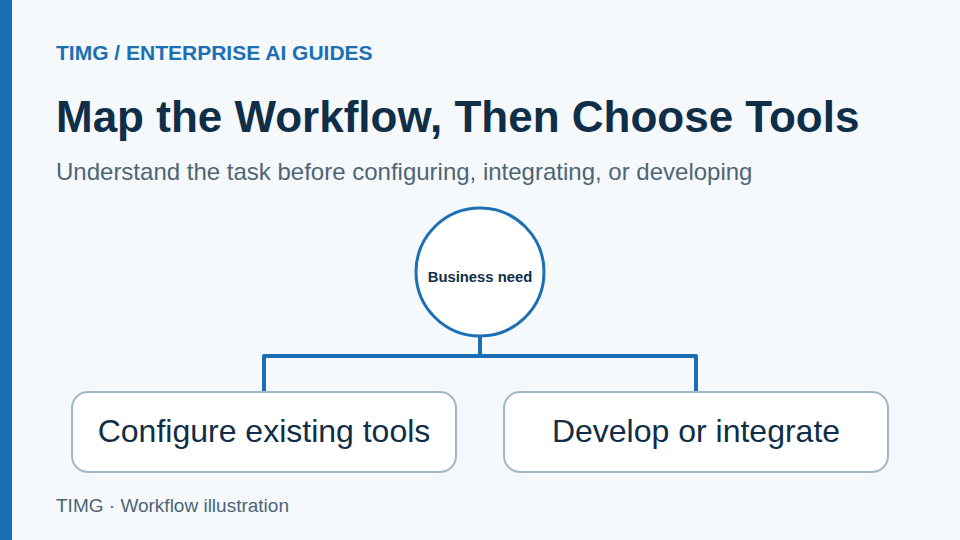
Clarify the business problem first
Helping an employee write an email faster and automatically linking inquiries to customer and quotation records are different problems. The first may be solved by configuring an existing tool; the second also involves data, permissions, and coordination across systems.
- Describe task inputs and outputs
- Specify who judges whether the result is acceptable
- Identify whether work spans multiple roles or systems
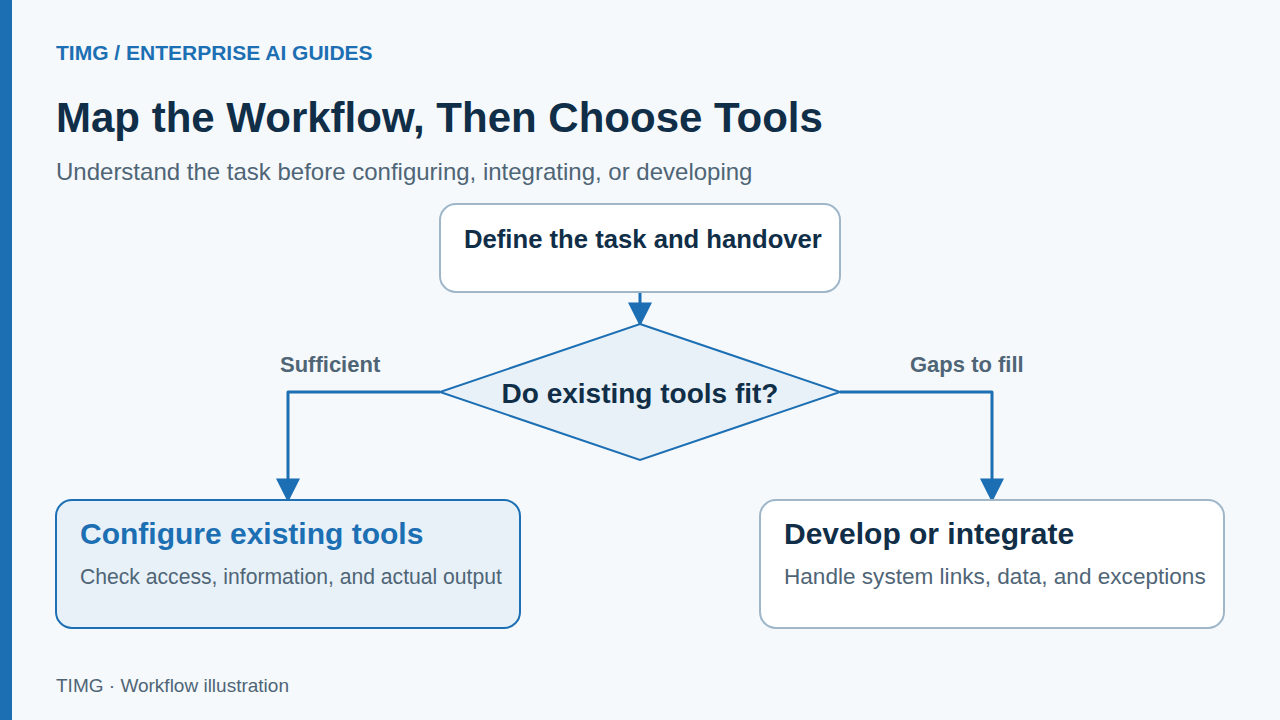
Configure first when existing capabilities are sufficient
When the task is stable, data is accessible, and a tool already has the relevant functionality, first test whether configuration, templates, or connectors can meet the need. Judge by actual task performance and maintenance cost, not the length of a feature list.
- Have users try their own tasks
- Confirm that information will not require duplicate maintenance
- Check export, handover, and ongoing use arrangements
Use engineering when deeper coordination is required
If the difficulty lies in linking information across systems, assessing exceptions, or continuous operation, design the workflow, system interfaces, and human takeover together. Business and engineering staff need to walk through the process, validate rules, and handle exceptions jointly.
- Have business experts and engineers define rules together
- Include critical permissions and human confirmation in the design
- Validate complex steps in a limited pilot
Lighting export example: quotation drafts
An existing tool can draft a reply in isolation. Linking customer specifications to the product catalog, preparing a quotation draft, and initiating approval also requires agreement on data sources, pricing responsibility, and the scope of system writes.
For example, a reply draft may meet an individual's writing need without completing a team's quotation workflow. That workflow also requires finding customer records, referencing valid models and pricing terms, completing approval, and saving results. Validate each of these tasks individually.
- First verify that requirements are organized reliably
- Then connect product and customer records
- Have a salesperson confirm formal quotations
Choose based on results and maintenance arrangements
When comparing options, consider who operates the application, how failures are handled, whether it can be handed over, and the cost of future workflow changes. Choose an approach that meets the current business scope while leaving room to expand.
- Tool configuration also needs acceptance testing
- Custom development should leave documentation and reusable components
- Decide on expansion after the pilot meets its criteria
Compare three approaches on the same task
Prepare the following materials and review each item with the business owner. The specific fields and criteria should reflect the workflow you select.
- Define representative inputs, acceptable outputs, and exceptions so tool configuration and development options use the same samples.
- Record manual copying, supplementary entry, approval, and cross-system handovers instead of comparing a single generation alone.
- List accounts, interfaces, data export, recurring costs, and maintenance ownership to identify constraints on later replacement.
- Configure existing capabilities when sufficient; integrate or develop where gaps prevent completion of business work.
Frequently asked questions
If an off-the-shelf tool gives an impressive demonstration, when is development or integration still needed?
Put the demonstration back into a real task and check whether it needs data from multiple systems, role-based permissions, record updates, approval, or failure recovery. Configure work the tool already covers; develop the missing connections, rules, and work entry points. Compare interface requirements, operating costs, and maintenance responsibilities together.
An enterprise has already tried several AI tools. How can it avoid simply adding more?
Follow frontline staff through their actual work and record each tool's inputs, outputs, duplicate entry, and manual handovers. Focus on one business outcome to identify what works and where connections are still missing. Then decide which tools to retain, connect, or replace, confirming information export, account ownership, and migration arrangements in advance.